Louis Chênevert is a retired aerospace industry leader who was president of Pratt & Whitney before he advanced to the C-suite of its parent company, United Technologies Corporation (UTC). He ultimately served as CEO, president, and chairman of UTC until his December 2014 retirement.
At both Pratt & Whitney and UTC, Mr. Chênevert presided over several milestone achievements. For example, he oversaw the development and production of the Pratt & Whitney F135 turbofan jet engine, the sole-source engine powering the US military’s F-35 stealth strike fighter.
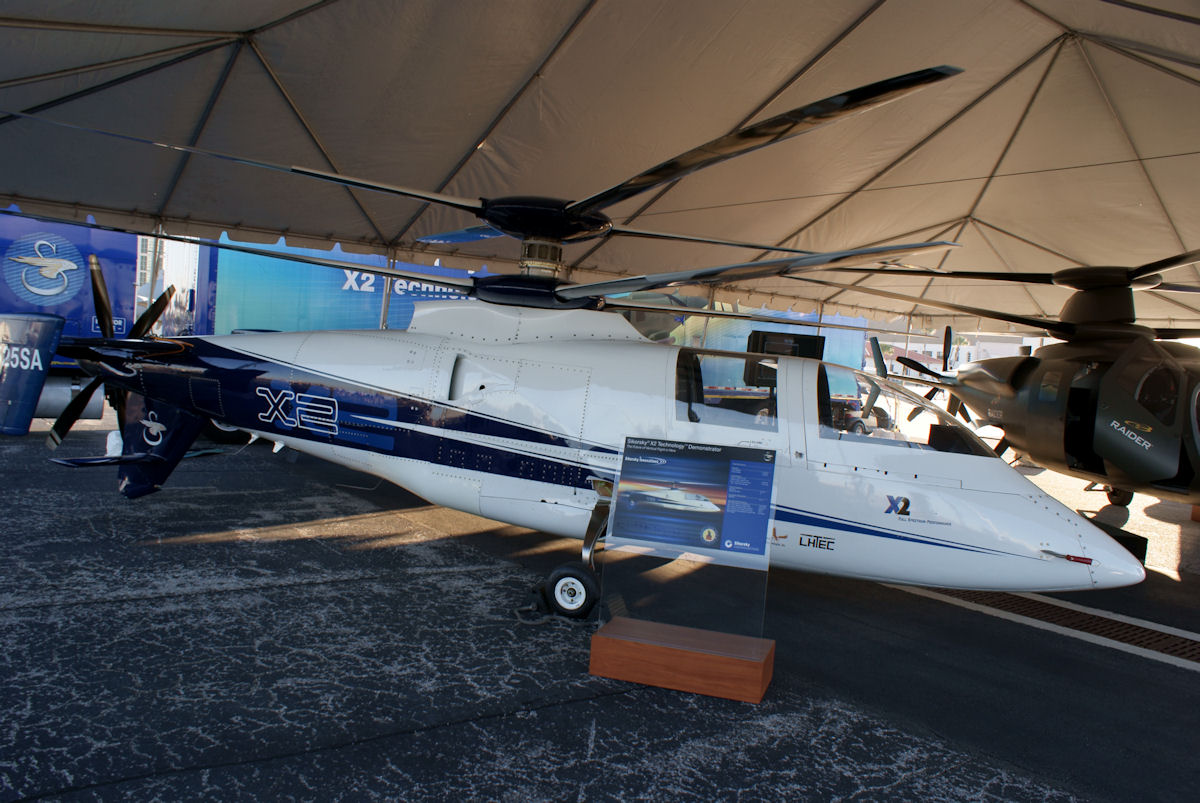
Another of UTC’s most impressive accomplishments during Mr. Chênevert’s tenure was the development of the X2 helicopter by subsidiary Sikorsky Aircraft. This experimental aircraft doubled the speed of helicopters and changed its noise signature. Its groundbreaking technology was scaled up for later helicopter models.
Features and Development
Developed as a technology demonstrator, the Sikorsky X2 was an experimental high-speed compound helicopter with coaxial rotors. The X2 project—self-funded on a $50 million budget—was announced by Sikorsky in 2005, with the goal of increasing helicopter speeds. A single helicopter was built. Three years later, the X2 made its maiden flight. Two years after that, it shattered a speed record by achieving 250 knots.
Powered by an LHTEC T800-LHT-801, 1,563 shp engine, the X2 was designed to be deployed in several types of military missions: attack, close-air support, search and rescue, and armed reconnaissance. Sikorsky’s tests showed that the X2 produced the same noise level at 200 knots that other helicopters generated at half that speed.
Notably, the X2 solved a common issue in helicopter flight: the retreating blade stall. This can cause a dangerous loss of lift on one side of the rotor and limits forward airspeed. The X2 addressed this problem with coaxial blades that experience retreating blade stall at the same time, counteracting each other. Other advanced features—including an integrated fly-by-wire system, high lift-to-drag rigid blades, integrated propeller drive system, and vibration control measures—combined to reduce this limiting factor and allow for higher speeds.
The development of the X2 drew on the technologies and expertise from a number of previous projects. The S-69/XH-59A Advancing Blade Concept Demonstrator had proven that it was possible to create a high-speed coaxial helicopter when utilizing two jet engines for auxiliary propulsion. The Cypher unmanned aerial vehicles had demonstrated unique features of coaxial flight control with a fly-by-wire aircraft. Advances had also been made in composite rotors and transmission design through the RAH-66 Comanche. At the same time, the Black Hawk provided insights into the development of counter-vibration technologies.
First Flights
The Sikorsky X2 made its first flight in 2008, taking off from a Schweizer Aircraft facility (then a division of Sikorsky) in New York State. During the 30-minute flight, the helicopter performed several maneuvers, including hovers and forward flight. For the next two years, the X2 project was in flight-test phase. In the summer of 2010, the X2 unofficially broke the Fédération Aéronautique Internationale(FAI) world record speed for a rotorcraft when it flew faster than 225 knots during a test in Florida.
Ultimate Record-Breaking Speed
The X2 achieved its historic 250-knot speed a few months later on September 15, 2010, during its 17th flight. Piloting the aircraft was Kevin Bredenbeck, chief pilot and director of flight operations for Sikorsky and the X2 project. He was also the pilot on the helicopter’s first flight and when it broke the 225-knot record.
The 250-knot level flight speed was more than twice that of traditional helicopters in the weight category of the X2, representing an enormous technological and performance advancement. Articles at the time also noted that the test flight was successful in other ways: the X2 demonstrated low vibration levels and a low-pilot workload.
Sikorsky president Jeffrey P. Pino celebrated the achievement, stating, “The aerospace industry today has a new horizon. The X2 technology demonstrator continues to prove its potential as a game-changer, and Sikorsky Aircraft is proud to be advancing this innovative technology and to continue our company’s pioneering legacy.”
2010 Collier Award
Sikorsky received the 2010 Robert J. Collier Trophy for the development of the X2. This annual award of the National Aeronautic Association recognizes excellence and groundbreaking advances in the fields of aerospace and aeronautics. In particular, the 2010 award was bestowed in recognition of the X2’s 250-knot speed, which set the stage for future advancements in helicopter speed over the next decade. The team behind the X2 helicopter also received the Howard Hughes Award from the American Helicopter Society in recognition of their cutting-edge design.
X2 Technology Lives On
Though he retired from UTC in 2014, Mr. Chênevert remains proud of the Sikorsky X2’s achievements, as well as the further advances in the aerospace industry that were inspired by this pioneering project. Now part of Lockheed Martin, Sikorsky has iterated upon and scaled up the X2 technology to create next-generation military helicopters, including the S-97 Raider and the SB>1 Defiant.
As for the original X2 demonstrator helicopter, it is now part of the National Air and Space Museum—another testament to its historic achievements. Those interested can see it on display at the museum’s Steven F. Udvar-Hazy Center in Chantilly, Virginia.